Know whether each change worked
Every change you ship is measured over the 28 days before and after, against the rest of your store. You get a figure with a range, or a plain answer that it can't tell yet.
Each change you ship, measured over 28 days before and after against the rest of the store.
Measured against the rest of the store
Not against last month, which mixes in the season and the weather.
Name the products or pages the change touched and what should move: orders, visits, Google clicks, enquiries or AI answers. The pages it didn't touch are the comparison.
A model learns how the two moved together before the change, then shows what would have happened without it.
Explore measurementChangeDelivery dates above the add to cart button
Orders a day, the 14 products it touched
Change shipped
18 Aug15 Sept12 Oct
These productsAfter the changeThe rest of the store, scaled to themWhat would have happened, with its range
+18%
Probably 18% more orders of these productsSomewhere between +9% and +27%, compared with how the rest of the store did
28 days before, 28 days after

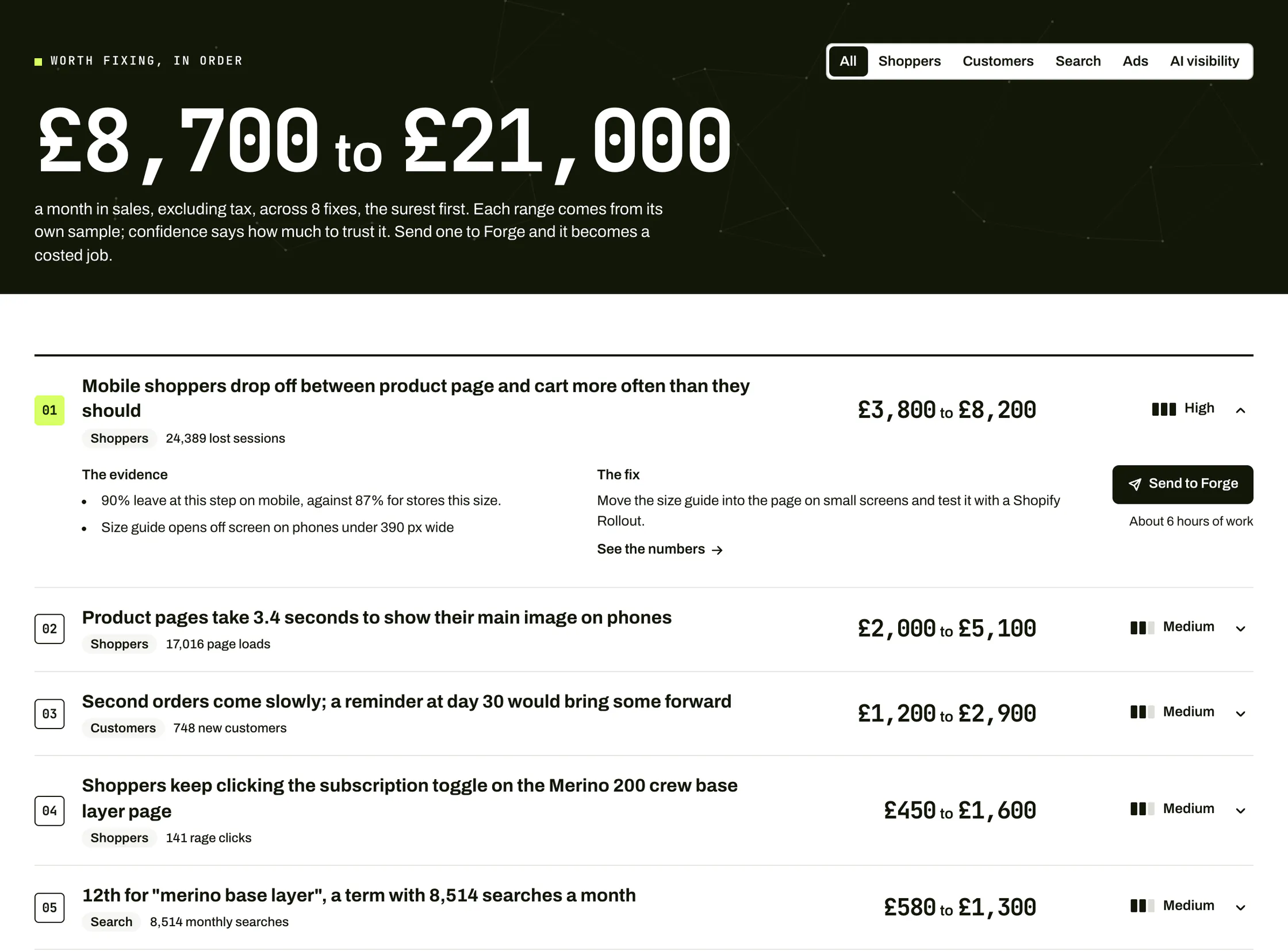
Every fix starts on one ranked list
Surest first, with a value range in sales a month.
Apply a fix in the app, where it's confirmed and logged, or send it to Forge as a costed job. The test starts the day it goes live.
Each fix's payoff is an assumption until Impact has measured a fix like it.
Send a fix to Forge
A plain answer when it can't tell
Never a number it can't stand behind.
A test that can't see a change says so in words. Too small, too few, or nothing steady to compare against are all answers you can act on.
Before you ship, it says how small a change it could see.
Explore shoppersThe plain answers
- Probably 18% more orders. Between +9% and +27%, against the rest of the store.
- Too small to measure. The range runs from worse to better.
- Too few to measure. These pages see too few orders to tell.
- Can't measure this one. Nothing steady to compare against.
- Measuring. 12 of 28 days in.
- 28
- days before and after every change you ship
- 5
- things a change can move: orders, visits, Google clicks, enquiries, AI answers
- Range
- on every result, with the most likely figure in it
- £0
- a month for impact
Frequently asked questions
Why 28 days?
Long enough to cover four full weeks, so every weekday counts the same number of times, and short enough that you hear back within a month of shipping. A small store may be read in weekly totals instead of days.
Why compare against the rest of the store?
Because the rest of the store lives through the same season, sales and news as the pages you changed. If both rise, the change didn't do it. If only the changed pages rise, it probably did.
How sure is the range?
It's the range the result is likely to sit in, not a guarantee. Forge Mark checks it by pretending changes happened on dates when nothing did, and widens the range when your figures are noisier than the model expects.
Does the change have to come from Forge?
No. A change you made yourself is measured the same way, from the pages or products it touched and the day it went live.
Can it measure an ad change?
Changes made through the Ads suite are read at 7, 14 and 28 days on the figure they were meant to move. For a whole channel, a holdout test in Measurement gives the firmest answer.
What does it cost?
Nothing. Impact is part of the free app. See pricing.

Measure your next change.
Connect your store in a few minutes, read only, and see the fixes worth making first, then whether each one worked.